Contents
What is a stone? Even if there are many types of stone in the world, we can find a unique stone definition that goes well with all stone types. In the stone definition we can find the concept of hardness: the stone is in fact a “hard and solid substance”, in the first place. Secondly, dictionaries tell us where we can find rock and stones, that is to say “in the ground” (origin).
In some dictionaries we can also find reference to its nature with the phrase “formed of mineral matter” (and depending on the minerals inside we can have in fact different types of stone). Finally, most dictionaries converge in adding one last characteristic to the stone: its purpose: “often used for building houses” is the most common statement.
This is certainly the most interesting aspect of the stone definition, that is, that the concept of stone is closely and clearly linked to the act of building and in particular to building houses. Therefore, here are the 3 fundamental aspects of each type of stone: it is something hard, something natural found in the ground and something we mainly used for building houses and much more.
Now that we know that stone is an element found in nature, we must also know that the formation process is not the same for all types of stone. Natural stone is formed through a process called the “rock cycle” which can last from thousands up to millions of years to complete.
The so-called “rock cycle” gives birth to 3 main types of stone: igneous, metamorphic and sedimentary. Each of these types of stone undergo specific processes that involve different physical changes such as eroding, melting, cooling, compacting or deforming. Let’s now see each of these types of stone in detail.
The word “igneous” comes from latin “ignis” which means fire. As a matter of fact, the formation of this type of stone involves the action of very high temperature and heat. In particular, these rocks are the result of the cooling of the magma (which is nothing more than molten rock). This phenomenon can take place either on the Earth’s surface (extrusive igneous rocks) or beneath the surface (in this case we talk about intrusive igneous rocks).
This category has to do with a process of changing. The term “metamorphic” in this case comes from Greek and can be translated as “the after form”. In geology, a metamorphic rock is a rock that has gone through changes in texture and composition due to actions such as pressure, high heat or chemical processes.
As the word itself suggests, “sedimentary rocks” originate from sediments: silt, sand and organic matter (such as calcareous skeletons of organisms) just to name a few. With time, these elements are compressed and cemented together to form solid rock. sandstone, limestone and coal are typical examples of sedimentary rocks.
We have now analyzed the different origin of igneous, metamorphic and sedimentary rocks. But, is there a way to distinguish them by watching and touching them? Are there unique characteristics we can recognize in these types of rock? Yes, indeed.
Let’s start by watching the layering of the stone: igneous rocks are not layered; sedimentary rocks have crystals of various sizes while metamorphic rocks have crystals that are the same size. Secondly, let’s watch the grain and appearance: sedimentary rocks may have whole or partial fossils such as leaves or shells; metamorphic rocks often have a metallic appearance while igneous rock may have a vesicular texture such as pumice.
In English language and in many other languages the words “rock” and “stone” are interchangeable in their use. Actually, there is a difference between the two terms. Speaking about size, a rock is comparatively larger than a stone.
Regarding the material, a rock can be either hard or soft and it is composed by several minerals and stones; a stone is generally hard and made of non-metallic matter. Finally, a rock is immovable while a stone is movable.
Once clarified the difference between rock and stone, we would like to highlight that stones can be classified on the basis of their mineral content and geological formation process. The main aspects from which a stone can be recognized are its hardness, its color and its crystal formation. We’ll now see some very popular types of stone which differ from each other in various characteristics such as strength, density, porosity, absorption, resistance to external agents and others.
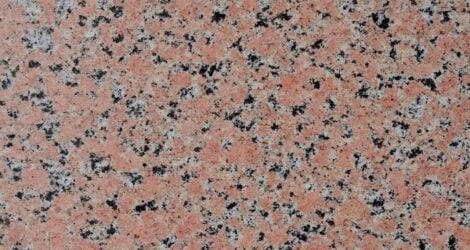
Granite is an igneous rock which forms from the slow crystallization of magma below the Earth’s surface. Its aesthetic features such as the granular structure and wide range of colors due to the mineralogical composition (mainly quartz, feldspar and mica) make it one of the most popular natural stones used in the building sector. For its hardness and resistance to abrasion, weathering and acidic agents, granite is commonly used to create marvelous kitchen countertops.
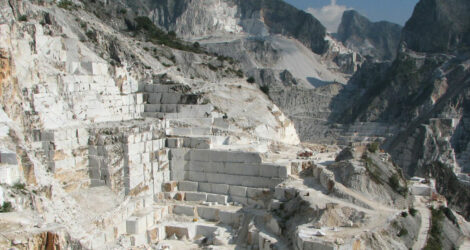
Marble, probably the most famous building stone in the world, is a metamorphic rock that comes from the transformation of a sedimentary rock through the action of heat and pressure. Marble is a strong material and can be polished to become incredibly bright and shiny.
There are numerous types of marble with very different colors: all these varieties can be made even more unique through different finishes (polishing, sandblasting, bush-hammering, flaming and so forth). Compared to granite, marble is a more delicate stone: as a matter of fact, some useful tips to treat this stone properly are to deal with stains immediately, to clean the surface with gentle soap avoiding acidic substances and drying promptly with a clean cloth.
Limestone is a rock mainly composed of calcium carbonate, like marble. However, the big difference between limestone and marble is that limestone is a sedimentary rock while marble is a metamorphic rock formed by the recrystallization of limestone.
Even if limestone is softer and more porous than marble, it is frequently used as a building stone for its versatility. Among the typical colors of limestone, we find white, gray and black. One of the most famous varieties of limestone is travertine, marvelous stone used for the realization of flooring and wall cladding.
Another sedimentary rock as limestone is sandstone. Sandstone is formed through the compaction and cementation of sand grains (mainly quartz and feldspar) in thousands to millions of years. Its color depends on the color of these sand grains as well as the impurities found within the rock. Sandstone has been used since prehistoric times for construction (for example for paving and facades) because it is easy to work and moderately resistant.
Quartzite is a metamorphic rock that is formed when sandstone is subjected to the action of heating and pressure. Typical color of quartzite is gray or white but it can come in different shades depending on the presence of elements such as hematite or other minerals. Quartzite has always been a popular decorative stone and in recent years it has been increasingly used for the realization of countertops since it is even harder and more resistant than granite.
Onyx is a valuable stone mainly used in jewelry. The term “onyx” generally refers to two completely different types of rocks: siliceous onyx (normally black in color streaked with white) and calcareous onyx, also called “Egyptian onyx” which can be brown or green depending on its origin.
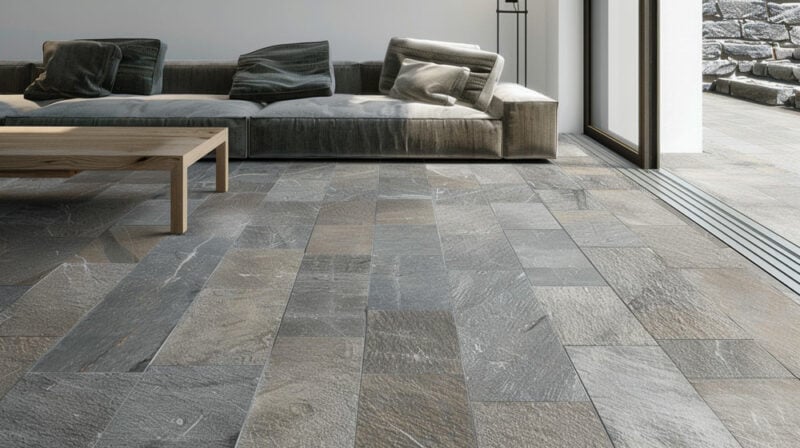
That of natural stones is a vast world where every material is unique. Here we would like to introduce two less common stones but with extraordinary properties: slate and soapstone. Both are metamorphic rocks but the first, of clayey origin and grey-black in color, is a stone that easily flakes into thin slabs and is used for roofing, blackboards and floors.
The second one, on the other hand, is a variety of compact talc with a greenish color. Despite its softness, soapstone is also durable, heat-resistant and has a high heat storage capacity. The outer layers of the Christ the Redeemer sculpture in Rio de Janeiro are made of soapstone.
Natural stone is one of the best options both for building projects both for its beauty and for its characteristics of durability and resistance. Nevertheless, for each application, mood and architectural project you need to choose the right stone so that the final result is aesthetically beautiful and correct from a functional point of view.
There are many things to consider starting from the installation place: simply, a floor should resist trampling while a wall should not. Or, choosing a porous stone for a kitchen countertop is not the best choice since it can be ruined by food stains. Don’t forget the color: a white stone will make the room appear larger compared to dark stones.
Last but not least, your budget; not only the variety of the stone makes its price but also the dimensions of the blocks or slabs.
As we have explained previously, there are numerous types of stones, each type has many variations, many colors, different types of cuts, finishes and so forth. For all these reasons we suggest to rely on field experts who can give the necessary support to make the best choice.
If you have the opportunity, an excellent experience would be to go directly to the quarry to personally see and touch the stone products for your project. Online purchases are possible but always supported by competent people.
Even if there are specific tips for each natural stone, we can say that there are few good tips that can be applied to all products. Firstly, remove the stains immediately and do not let them settle. Secondly, use a gentle soap to clean the surface and avoid aggressive chemical agents. Finally, consider to seal your natural stone in order to add a layer of protection which act as a barrier between the surface and other substances.
First thing to say is that natural stone is one of the most sustainable building material available on the market. Natural stone processes produce small excess material and is highly re-cyclable.
Natural stone is extremely durable and can be maintained with natural products and with minimum water. From an ethical and sustainability point of view, always try to choose local stone products to minimize transport and promote the local economy and excellences.








Luxurious furniture in lightweight marble
Dedalo is a company from Carrara that designs and produce monolithic luxurious furnishings in lightened marble, with a contemporary design. Our goal is to reaffirm the use of marble in everyday life without renouncing, for reasons of weight, to its three-dimensional vocation, proposing sculptural and extremely engaging shapes.