Contents
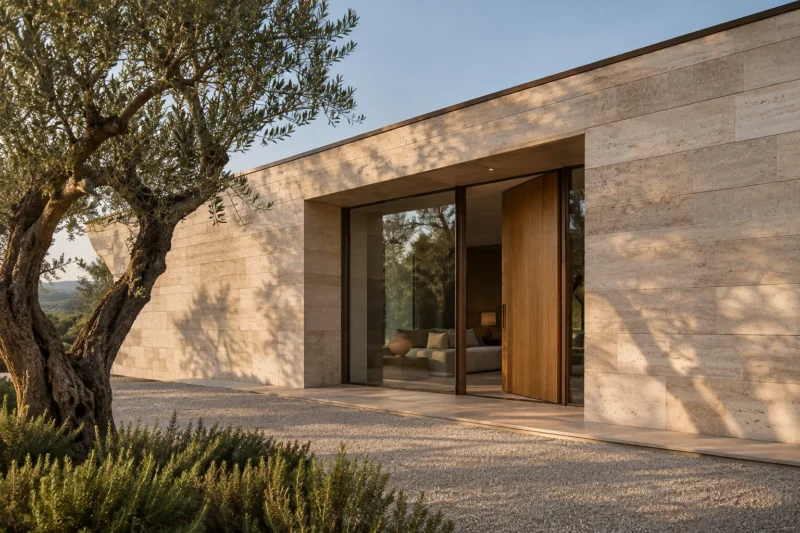
The most widely used materials for exterior stone cladding are dense, low-absorption natural stones such as quartzite, granite, gneiss (Luserna stone), slate and some travertines and marbles, along with manufactured stone veneer and stone-look porcelain. For exposed walls and facades the choice comes down to three values: freeze-thaw resistance, water absorption and the weight the substrate can carry. Color and format come after.
This guide compares the stones, explains which technical data to ask for and how installation changes between garden walls, facades and pool areas.
Natural stones suited to exterior cladding share low porosity and good resistance to freeze-thaw cycles. Within the same family, however, individual varieties vary a lot: always ask for the data of the specific stone.
| Stone | Look | Strengths outdoors | Watch out for |
|---|---|---|---|
| Quartzite | Split-face or honed surface, gray, beige and golden tones | Very hard, low absorption | Heavy in split-face thicknesses |
| Granite | Speckled grain, colors from white to black | Highly resistant to frost, wear and pollution | A less “warm” look than limestones |
| Gneiss (Luserna stone) | Gray-green, split into slabs | Traditional in Alpine areas, handles frost well | Limited color range |
| Slate | Dark gray, black, cleft surface | Splits into thin, light slabs | Dark finishes get very hot in the sun |
| Travertine | Beige and walnut, with natural holes | Warm look, widely used in Italy | The holes trap water and dirt: choose it filled or with a suitable finish |
| Sandstones and soft stones | Sand and gray tones | Easy to work | More absorbent: in cold climates check the frost-resistance data carefully |
| Marble | Veined, whites, grays, colors | Custom fabrication, continuity with interiors | Polish wears off outdoors; thin slabs on highly exposed facades need careful design |
Among natural stones, the most durable for exterior cladding are generally granites and quartzites, thanks to their hardness and low water absorption. Here too, the data should be read for the individual variety.
Learn more: Luserna stone.
Learn more: travertine: characteristics and types.
Learn more: slate.
Marble works well outdoors on entrances, wainscots, columns, garden walls and facades of moderate size, with matte or textured finishes: honed, brushed, bush-hammered, sandblasted. Outdoors, a polished finish wears off within a few years because of rain, so it is not worth choosing for exposed surfaces.
On large facades with strong sun exposure, marble needs specific engineering. Thin slabs of some marbles can bow over time because of thermal cycles: the best-known case is Chicago’s Aon Center, clad in 1973 with thin Carrara marble panels that were later replaced with granite. Slab thickness, marble variety and anchoring system should therefore be decided together with the stone fabricator.
Learn more: marble facades.
Learn more: marble cladding for exteriors and interiors.
Besides natural stone, two alternatives are used for exterior cladding: manufactured stone veneer, a mix of cement, aggregates and pigments cast in molds, and stone-look porcelain tile.
| Natural stone | Manufactured stone | Stone-look porcelain | |
|---|---|---|---|
| Look | Every piece is different, ages without losing character | Repeats the patterns of the mold | Digitally printed stone, uniform surface |
| Weight | High, depends on thickness and stone | Lighter | Light |
| Freeze-thaw resistance | Depends on the stone: must be verified | Depends on the product: must be verified | Generally very high thanks to near-zero absorption |
| Repairability | Can be refinished and restored | Limited | A broken piece is replaced |
| Made to measure | Yes, including large slabs and special pieces | Catalog formats | Catalog formats |
Manufactured stone is widely used over exterior insulation systems (EIFS) because it weighs less than natural stone, but it must be installed only with the system specified by the insulation manufacturer. Manufactured stone makes sense when low cost and fast installation over large areas matter most. Natural stone makes sense when the cladding has to last for decades and be part of the building’s architecture.
A durable exterior cladding stone is recognized by its test data, not by its trade name. Two stones that look alike can behave in opposite ways in frost.
The main risk for exterior stone is water that gets into the pores and freezes, expanding. That is why the two values to ask the supplier for are:
For cladding slabs, the European product standard is EN 1469: a stone sold for cladding in Europe should come with a declaration of performance that lists these values.
The weight of the stone cladding has to be compared with the substrate that carries it. There are two main systems:
Over exterior insulation, stone should be installed only with systems certified for that type of insulation: a generic adhesive is not enough.
Exterior cladding calls for finishes that do not lose their look in the rain and do not highlight dirt: natural cleft, bush-hammered, flamed (on granites), sandblasted, brushed, honed. A polished finish is for interiors and sheltered areas.
The format determines the pattern of the wall and the installation time:
With irregular stones and panels, it helps to lay out a dry run on the ground before installing, to distribute colors and sizes.
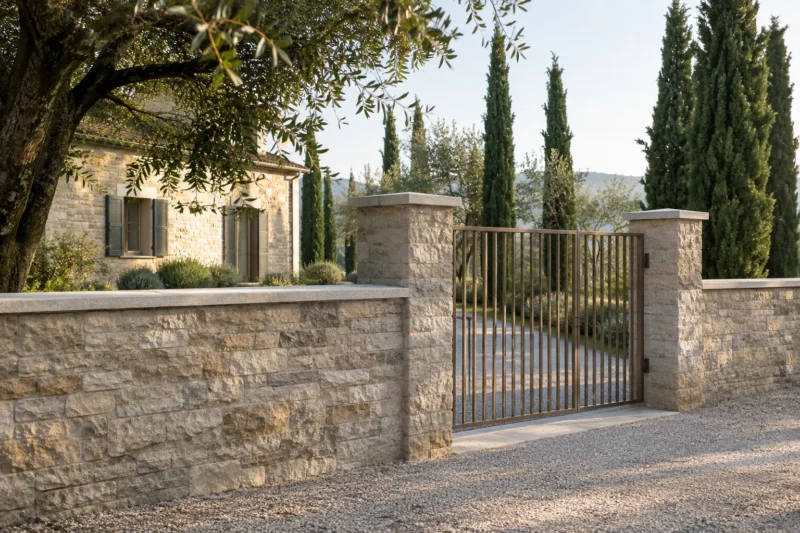
On facades, stone can cover the whole building or only some parts: the base, the entrance, one volume or the columns. On tall, extensive surfaces, the installation system should be designed before choosing the material, because it determines the possible thicknesses and formats.
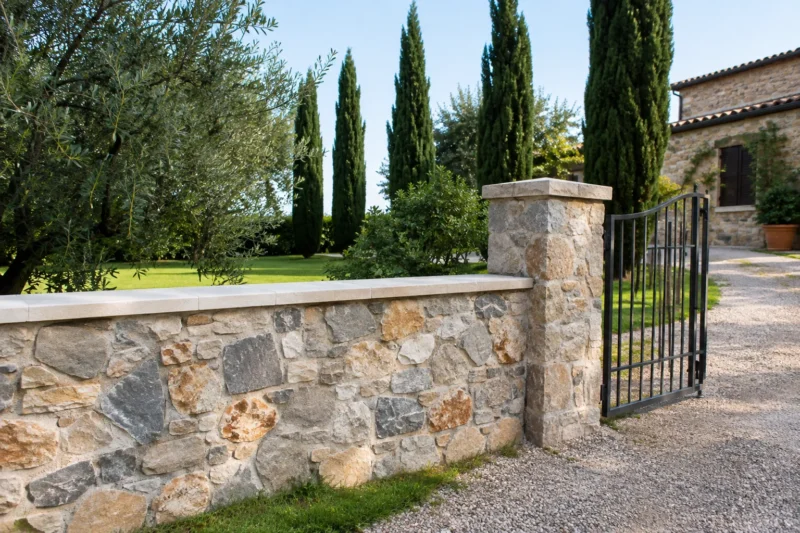
On garden walls stone is seen up close, so corners and tops matter. Corners should be finished with L-shaped corner pieces or with an installation that wraps the texture around the edge, otherwise the cladding looks applied. The top must be protected with a wall cap with a drip edge, which keeps water from getting in from above behind the cladding.
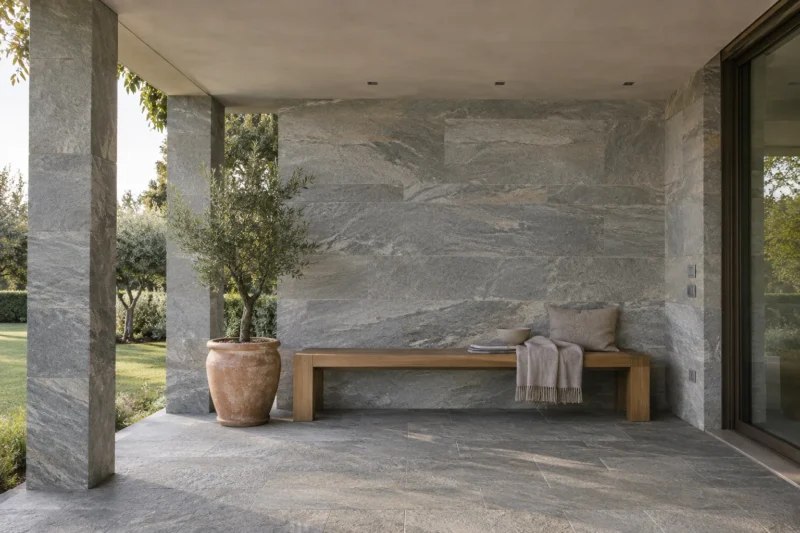
Entrances and porches are sheltered, so they can take more delicate stones and finer finishes. Around pools, on the other hand, the stone gets constant splashing and pool chemicals: you need low-absorption stones and compatible sealers, and for saltwater pools a specific check with the supplier.
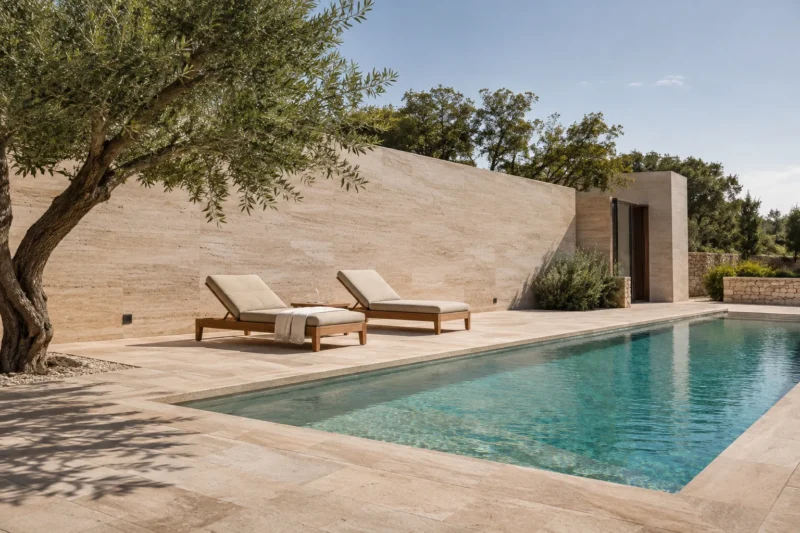
In modern homes, stone is used on a few chosen surfaces, in contrast with smooth stucco, glass and metal: strips or regular slabs in grays, beiges and charcoal. In farmhouses and country homes, irregular stones in warm, mixed tones work best, laid without repeating patterns. Either way, the stone has to work with the roof, windows and outdoor paving: if the building already has stone elements, the new stone should echo their color and size.
Learn more: stone for outdoor flooring.
The cost of exterior stone cladding depends on the material and above all on the installation system. The line items are: the stone (per square foot or square meter), installation (also per unit area, higher for irregular stones laid by hand), special pieces for corners and caps, adhesives or the subframe for a ventilated facade, and scaffolding for tall facades.
Manufactured stone and porcelain are the most affordable options. Split-face natural stone costs more for the material and the longer installation. Custom-fabricated marble or stone slabs on a ventilated facade are the top tier.
Exterior stone cladding is cleaned with low-pressure water and pH-neutral stone cleaners. A high-pressure washer can erode soft stones and wash out the joints. Moss and lichen should be treated with specific products that are compatible with the stone, tested first on a hidden area.
A breathable water-repellent sealer reduces the water absorbed by more porous stones, but it is not needed on all of them: on stones that already absorb little it may be useless. The most effective maintenance is still correct installation: caps on garden walls, intact joints and no standing water at the base of the walls.








Luxurious furniture in lightweight marble
Dedalo is a Carrara-based company that designs and makes monolithic luxury furnishings in lightweight marble with a contemporary design. Our goal is to bring marble back into everyday life, with sculptural and engaging shapes, without giving up its three-dimensional character because of its weight.
Informazioni legali | I testi, le informazioni e gli altri dati pubblicati in questo sito nonché i link ad altri siti presenti sul web hanno esclusivamente scopo informativo e non assumono alcun carattere di ufficialità. Non assume alcuna responsabilità per eventuali errori od omissioni di qualsiasi tipo e per qualunque tipo di danno diretto, indiretto o accidentale derivante dalla lettura o dall’impiego delle informazioni pubblicate, o di qualsiasi forma di contenuto presente nel sito o per l’accesso o l’uso del materiale contenuto in altri siti. In linea con l’innovazione che ci distingue, alcuni testi e contenuti visivi di questo sito sono sviluppati con il supporto avanzato di sistemi di IA.