Contents
Zaha Hadid, also known as “architect Hadid Zaha,” was one of the most influential and innovative figures in modern architecture. Her legacy, marked by avant-garde projects and revolutionary design, continues to inspire and challenge the boundaries of architectural creativity. This article explores the life, works, and influence of Zaha Hadid, providing a comprehensive overview of her unique contribution to the world of architecture and design.
Born in Baghdad, Iraq, on October 31, 1950, Zaha Hadid grew up in a wealthy and educated family. She had the opportunity to travel extensively and receive a top-tier education. After attending schools in Switzerland and England, she studied mathematics at the American University of Beirut. Her passion for architecture materialized when she enrolled at the Architectural Association School of Architecture in London in 1972. Under the mentorship of figures like Rem Koolhaas and Elia Zenghelis, she began developing her unique and visionary style, laying the foundation for a career that would redefine the global architectural landscape.
After graduating, Hadid worked at the Office for Metropolitan Architecture (OMA) under Koolhaas before opening her own studio in London in 1980. Her first major project, The Peak Club in Hong Kong, catapulted her into the spotlight, even though it was never built. With projects like the Vitra Fire Station in Germany and the Rosenthal Center for Contemporary Art in the United States, Hadid solidified her reputation as a cutting-edge architect known for her radical approach and fluid, dynamic forms.
Throughout her career, Zaha Hadid received numerous awards and honors, becoming the first woman to win the prestigious Pritzker Architecture Prize in 2004. Other notable accolades include the Royal Gold Medal from RIBA and the title of Dame Commander of the Order of the British Empire (DBE). These awards attest to her extraordinary skill and innovation, as well as her lasting impact on contemporary architecture and her pioneering role for women in the field.
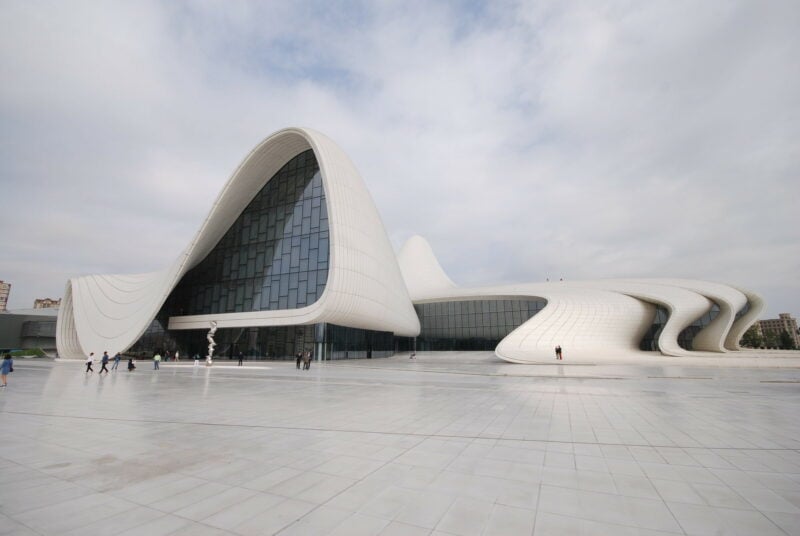
Hadid’s works are renowned for their complexity and boldness. Among her most celebrated projects is the London Aquatics Centre, created for the 2012 Olympics, with its fluid lines evoking the movement of water. Another example is the Guangzhou Opera House in China, characterized by organic forms that blend seamlessly with the surrounding environment. The Heydar Aliyev Center in Azerbaijan, with its elegant and continuous curves, is perhaps one of her most recognizable and internationally acclaimed creations.
Zaha Hadid was not only an architect but also an innovative designer. Her furniture and design objects, often inspired by the same dynamic forms as her architecture, have found places in exclusive collections and museums worldwide. Hadid’s work in design demonstrated how architecture and design could interact and influence each other, creating functional as wells as highly artistic and conceptual pieces.
In addition to public buildings, Hadid designed numerous private works, such as luxury residences and commercial spaces. The Galaxy SOHO in Beijing, for example, represents a fusion of commercial spaces and offices, with a series of interconnected volumes creating a unique urban landscape. Her innovation also manifested in residential projects like the One Thousand Museum in Miami, a residential tower that combines futuristic aesthetics with comfortable living, revolutionizing the concept of luxury housing.
Hadid often collaborated with artists and other designers, exploring new creative territories and expanding the boundaries of her art. Notable among these collaborations is her work with German painter Karl Lagerfeld for the design of the Mobile Art Pavilion for Chanel, an itinerant structure that hosted contemporary art exhibitions in various cities around the world. These synergies allowed Hadid to experiment with new materials and technologies, further enriching her design language.
Beyond buildings, Zaha Hadid made significant contributions to interior design, characterized by sinuous lines and innovative spatial solutions. A notable example is the luxury restaurant and bar “Alaior” in London, where undulating surfaces and high-quality materials create a unique and enveloping atmosphere. Hadid seamlessly integrated architecture and interior design, transforming living and commercial spaces into immersive and sensory experiences.
Zaha Hadid’s approach was always multidisciplinary, integrating architecture, design, art, and technology. This method allowed her to create unique works that do not confine to a single field but explore the interconnections between different forms of creative expression. Hadid worked with engineers, artists, scientists, and designers, developing innovative and sustainable solutions that anticipated and often influenced future trends.
Zaha Hadid’s impact on modern architecture is immeasurable. Her unique vision and innovative approach have inspired numerous generations of architects worldwide. Her works, characterized by complex geometries and fluid forms, challenged traditional conventions and opened new pathways in architectural design. Emerging architects often cite Hadid as one of their main influences, recognizing her pioneering role in redefining the boundaries of contemporary architecture.
Hadid also influenced architectural schools of thought. Her deconstructivist approach, focusing on fragmentation and surface manipulation, has become a reference point for many architectural studios and academies. Architectural institutes worldwide have incorporated Hadid’s principles into their curricula, educating students to think unconventionally and explore new forms and materials. Her work continues to be studied and analyzed as an example of innovation and creativity.
Even after her death in 2016, Zaha Hadid’s studio continues to carry forward her legacy with numerous ongoing and future projects. The team of architects and designers at Zaha Hadid Architects still follows her principles and vision, creating buildings and spaces that reflect her distinctive style. Among the ongoing projects are new cultural structures, residential complexes, and public spaces in various parts of the world. These projects testify to Hadid’s enduring influence and the ongoing evolution of her innovative approach to architecture.
Zaha Hadid’s design philosophy was characterized by a radical and innovative approach. Influenced by Russian Constructivism and Deconstructivism, Hadid developed a unique architectural language based on fluid and complex geometries. Her vision was to create dynamic spaces that broke with traditional conventions, favoring continuity and fluidity of forms. Each of her projects is a testament to her commitment to pushing the boundaries of architecture, transforming spaces into exciting and engaging experiences.
Hadid was a pioneer in the use of advanced techniques and technologies in architecture. She integrated the use of CAD (Computer-Aided Design) and parametric modeling to develop complex forms and innovative structures. These technologies allowed her to explore new design possibilities and create buildings that challenge the laws of physics and traditional engineering. The use of cutting-edge materials and advanced construction techniques made it possible to realize bold and visionary projects, continuing to inspire the architectural world.
Another fundamental aspect of Zaha Hadid’s philosophy was the importance of inclusivity in architecture. Hadid firmly believed that architecture should be accessible and usable by all, regardless of their physical or economic capabilities. Her projects often included open and accessible public spaces designed to be used and appreciated by diverse communities. This commitment to inclusivity made her works not only beautiful and innovative but also socially relevant and democratic.
Zaha Hadid’s influence extends far beyond the confines of her London studio. Her international projects have transformed urban landscapes in Europe, Asia, America, and the Middle East. Buildings such as the MAXXI in Rome, the Galaxy SOHO in Beijing, and the Heydar Aliyev Center in Baku have become symbols of architectural innovation in their respective cities. Hadid brought her avant-garde vision to diverse cultural contexts, adapting her unique style to local needs without ever losing her distinctive signature.
Zaha Hadid successfully interpreted and valued the diverse architectural cultures she encountered. Each of her projects is a dialogue between her futuristic vision and local traditions. For example, in the case of the London Aquatics Centre, Hadid managed to combine modern forms with the functionality required by an Olympic building. Similarly, the Innsbruck funicular station reflects a harmonious interaction between contemporary architecture and the Alpine landscape. This ability to integrate different cultural elements made her works universally recognizable and appreciated.
Zaha Hadid’s international collaborations further amplified her global influence. She worked with numerous architectural studios, engineers, and artists worldwide, creating projects that combine diverse skills and visions. These partnerships enabled the development of innovative and sustainable solutions that reflect Hadid’s commitment to cutting-edge yet environmentally respectful architecture. These collaborations contributed to spreading her innovative approach and consolidating her reputation as one of the most influential figures in contemporary architecture.
The death of Zaha Hadid in 2016 left a void in the world of architecture. However, her legacy continues to live on through her numerous projects and the influence she had on architects and designers worldwide. The future of architecture will inevitably be influenced by her innovative vision and revolutionary techniques. Emerging architects are called to take up the mantle, continuing to challenge conventions and explore new possibilities, just as Hadid did throughout her career.
Zaha Hadid’s legacy will continue to live on not only through her buildings and projects but also through the Zaha Hadid Architects studio, which carries on her work with the same innovative spirit. Her works will be studied and admired by future generations, offering valuable inspiration and lessons. Additionally, Hadid’s influence will be reflected in the projects of those who worked with her and who will carry forward her unique approach to architecture. Her bold vision and commitment to innovation will continue to guide the world of architecture for many years to come.
Numerous tributes and commemorations have celebrated Zaha Hadid’s life and work. Exhibitions, conferences, and publications have been dedicated to her extraordinary career, highlighting her revolutionary contributions. Among these, the exhibition at the MAXXI in Rome and the Serpentine Gallery in London have provided a broad overview of her work and influence. These tributes not only acknowledge her exceptional talent but also her pioneering role in a male-dominated field. These commemorations will continue to keep Hadid’s memory alive and celebrate her lasting impact on architecture.








Luxurious furniture in lightweight marble
Dedalo is a company from Carrara that designs and produce monolithic luxurious furnishings in lightened marble, with a contemporary design. Our goal is to reaffirm the use of marble in everyday life without renouncing, for reasons of weight, to its three-dimensional vocation, proposing sculptural and extremely engaging shapes.