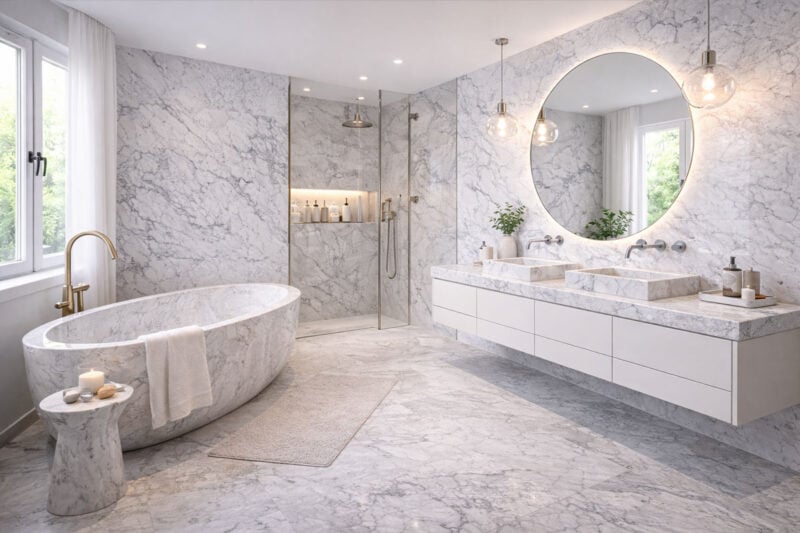
Contents
Marble bathroom countertops are not simply support surfaces, but architectural elements capable of defining the character of the entire space. In modern bathroom design, the countertop represents the visual focal point, the surface that most frequently comes into contact with the user, and the component that immediately communicates the overall quality level of the furnishings. Choosing marble means opting for a natural material with a strong aesthetic identity, as well as physical and structural characteristics that make it suitable for a humid environment like the bathroom, when properly treated.
Marble is a metamorphic rock composed primarily of calcium carbonate, formed through geological processes that took thousands of years. This natural origin gives the material a compact yet workable structure, with color variations and veining patterns that cannot be industrially replicated. Each slab is different from the next, and this uniqueness represents significant added value in an era where personalization plays a central role in interior design.
From a functional standpoint, marble offers a combination of compressive strength, dimensional stability, and the ability to be fabricated to custom specifications. It can be cut, shaped, drilled, and finished with millimeter precision, allowing perfect integration with vessel sinks, undermount sinks, or integrated basins. This design flexibility is one of the main reasons architects and interior designers choose it for mid- to high-end residential projects.

The decision to install marble bathroom countertops should be analyzed from three fundamental perspectives: aesthetic, technical, and economic. From an aesthetic standpoint, marble possesses visual depth and material richness that no synthetic material can reproduce with the same authenticity. Natural veining, created by complex geological processes, produces dynamic surfaces that interact uniquely with light, subtly changing appearance throughout the day.
From a technical perspective, marble is a material with high compressive strength and excellent long-term durability. When properly installed on a suitable structure and treated with specific water-repellent products, it can maintain its integrity and beauty for decades. It withstands the humidity typical of bathroom environments, provided prolonged exposure to acidic substances or aggressive cleaning agents is avoided.
From an economic standpoint, it represents an investment that positively impacts the perceived value of the property. A bathroom finished with marble immediately communicates construction quality and attention to detail, factors that also influence future real estate evaluations.
Marble’s elegance is not tied to temporary trends, but to an architectural tradition spanning centuries. Used in historic palaces, public buildings, and prestigious residences, marble has become a universal symbol of refinement. Installing marble bathroom countertops means bringing that cultural heritage into a functional everyday domestic space.
Marble surfaces possess a particular optical depth. In polished finishes, light slightly penetrates the surface layer before being reflected, creating a soft brilliance that never appears artificial. In matte or honed finishes, light is diffused more evenly, generating a sophisticated and contemporary material effect. This ability to adapt to different stylistic languages makes marble suitable for minimalist bathrooms with clean lines as well as classic settings with decorative cabinetry and ornate fixtures.
The uniqueness of each slab further contributes to creating spaces that cannot be replicated. Unlike industrial materials where patterns repeat, natural marble guarantees an unrepeatable composition, an increasingly sought-after element in personalized interior design.
One of the most common misconceptions concerns the supposed fragility of marble. In reality, from a structural standpoint, marble is extremely resistant to compression and stable over time. Its density makes it solid and compact, essential qualities for a surface that must support the weight of a sink and withstand daily use.
The true critical aspect is not mechanical resistance, but chemical sensitivity. Since marble is primarily composed of calcium carbonate, it can react with acidic substances. However, the application of modern protective treatments significantly reduces surface porosity and limits liquid absorption. This means that, in a normal residential setting, marble bathroom countertops can maintain their aesthetic characteristics for many years without significant damage.
In terms of dimensional stability, marble does not undergo significant expansion in interior environments. When properly installed on a suitable support structure, it does not warp or bend, preserving flatness and structural integrity over time.
Installing marble bathroom countertops directly affects the overall perceived quality of a home. Natural finishes are associated with a higher level of construction quality and greater design attention. This element is not merely aesthetic but also impacts perceived value in the event of resale or rental.
In the real estate market, the presence of natural materials such as marble helps position a property within a higher quality segment. The bathroom is one of the most scrutinized areas during property viewings, and marble countertops can influence the buyer’s final decision. Choosing marble communicates stability, long-term investment, and attention to construction details.
Selecting the type of marble is a crucial step because it affects not only aesthetics, but also cost, maintenance requirements, and the final visual impact of the bathroom. Each marble variety presents different color characteristics, internal structure, and levels of porosity. The evaluation must consider the architectural context, the amount of natural light available, and the overall furnishing style.
Light-colored marbles visually expand the space and reflect light more effectively, making them ideal for smaller bathrooms. Dark marbles create stronger contrasts and more dramatic environments, but require careful lighting design. The frequency of bathroom use also influences the choice, as some more compact varieties are slightly less absorbent than others.
Carrara white marble is one of the most widely used solutions for bathroom countertops due to its balance between elegance, availability, and relatively accessible cost. It features a white-to-light-gray background with soft, diffused veining that creates a harmonious and refined effect.
From a design perspective, Carrara marble is extremely versatile. It integrates seamlessly with modern cabinetry featuring clean lines as well as more traditional furnishings. Its brightness helps make the bathroom feel more open, especially in compact spaces. Although it is more affordable than rarer marbles, it maintains a high level of perceived prestige, making it a strategic choice for those seeking a balance between investment and aesthetic impact.

Black Marquina marble stands out for its deep black background crossed by irregular white veins. It is a bold visual choice, suitable for contemporary projects and environments where strong contrast with light walls or cabinetry is desired.
The dark surface emphasizes the veining, turning the countertop into a dramatic focal point. However, it requires more careful maintenance because water spots and mineral deposits may be more visible. From an aesthetic standpoint, it delivers a highly sophisticated result capable of giving the bathroom a distinctive and refined character.
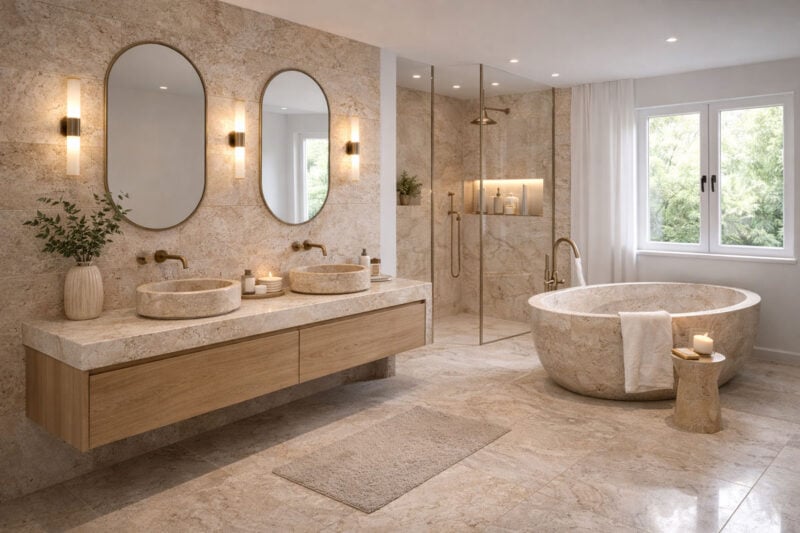
Travertine features warm tones ranging from beige to walnut and a structure characterized by small natural cavities. It is particularly suitable for bathrooms inspired by spa-like or organic atmospheres. Its aesthetic is softer compared to white or black marbles and conveys warmth and comfort.
Due to its higher porosity, proper sealing treatments are essential. When correctly protected, travertine can perform well even in humid environments while preserving its distinctive textured appearance.
Calacatta marble is considered a premium variety. It is distinguished by its bright white background and bold, wide veining, often featuring gray or golden tones. Its rarity and more complex extraction process contribute to its higher price compared to Carrara.
From an aesthetic perspective, Calacatta countertops become the undisputed focal point of the bathroom. It is a preferred choice in high-end interior design projects where a strong visual statement and a clear luxury identity are desired.
The distinction between natural marble and cultured marble is essential for making an informed decision. Natural marble is quarried in blocks and later cut into slabs. Each piece is unique, with unrepeatable variations in color and veining. Cultured marble, on the other hand, is a composite material made by mixing marble dust with synthetic resins, resulting in a more uniform and lighter product.
Natural marble offers superior aesthetic and commercial value but requires more attentive maintenance. Cultured marble is less porous and more consistent in appearance, yet it does not provide the same material depth or prestige as natural stone. The choice depends on budget, maintenance expectations, and the level of authenticity desired in the bathroom project.

Choosing custom marble bathroom countertops is the most effective solution for achieving a result perfectly integrated with the existing architectural space. Unlike standardized products, which impose predefined dimensions and finishes, custom countertops are developed through a precise design process that begins with an on-site assessment and concludes with millimeter-accurate installation.
Marble is particularly suited to custom fabrication because it can be cut, shaped, and finished with great precision. This makes it possible to adapt it to niches, out-of-square walls, existing cabinetry, or floating structures. The process is not purely aesthetic but involves structural considerations such as proper weight distribution, load-bearing support, and integration with plumbing systems.
Choosing custom fabrication also allows direct slab selection, making it possible to evaluate veining patterns and orientation in person. This ensures control over the final visual outcome and guarantees consistency with the overall bathroom design.
Accurate measurement is the most delicate phase of the entire process. Marble does not allow easy post-production corrections, since once cut, modifications can compromise structural integrity or aesthetics. For this reason, measurements must be taken with professional tools and extreme precision.
During this phase, wall irregularities, floor unevenness, and the exact position of drains and water supply lines are carefully verified. Even minor discrepancies can result in visible gaps or structural stress on the slab. The subsequent design phase considers the thickness of the underlying cabinet, the final ergonomic height, and the selected sink type.
Proper planning also accounts for marble’s weight, which can be significant, especially for thicker slabs or longer spans. Correct structural evaluation prevents deflection and ensures long-term stability.
The thickness of marble bathroom countertops affects both aesthetic perception and structural performance. The most common thicknesses generally range from three-quarters of an inch to one and a quarter inches, although high-end projects may use thicker slabs or laminated edge effects to create a more substantial visual impact.
Greater thickness conveys solidity and luxury but increases overall weight, which must be considered during structural planning. From a technical standpoint, marble performs well even at standard thicknesses, provided adequate support is ensured.
Edge finishing significantly influences the bathroom’s style. A straight edge communicates minimalism and contemporary design, while a rounded or profiled edge evokes more traditional settings. The chosen edge detail should align with the overall design language and the type of sink installed, creating harmony between functionality and aesthetics.
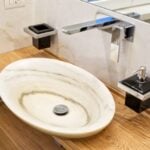
The choice between a vessel sink, undermount sink, or integrated basin dramatically changes the visual impact of marble bathroom countertops. A vessel sink enhances the marble surface, leaving it fully visible and turning it into the centerpiece of the room. In this case, cutouts are made only for drainage and, if necessary, faucet installation, preserving the continuity of the slab.
An undermount sink is installed beneath the countertop, creating a seamless surface and facilitating cleaning. This solution is especially appreciated in contemporary interiors because it reduces visual interruptions.
An integrated marble sink represents the most technically sophisticated option. In this configuration, the countertop and sink are fabricated from the same material, ensuring complete continuity. However, it requires more complex craftsmanship and a higher investment, as it increases production time and demands greater precision.
The price of marble bathroom countertops cannot be defined generically, since it depends on a series of technical, qualitative, and design-related variables. The final cost results from the interaction between the selected marble type, the countertop dimensions, the requested fabrication details, and the level of customization involved.
It is important to understand that marble is not a standardized material like industrial laminate. Each slab has unique characteristics and may originate from different quarries, with varying extraction and transportation costs. The quality of slab selection also affects pricing, as slabs with particularly harmonious veining or minimal imperfections generally command higher prices.
Pricing should be evaluated as a long-term investment. A properly fabricated marble countertop can maintain both aesthetic and functional value for decades, effectively amortizing the initial expense over time. Choosing marble is not merely a cost decision, but a quality and durability decision.
Cost per linear foot is the most commonly used reference parameter to estimate the price of marble bathroom countertops. However, this figure must be interpreted carefully, as it often does not include special fabrication details, additional cutouts, edge profiling, or protective treatments.
More common varieties such as Carrara white marble generally have a lower price point compared to rarer stones such as Calacatta. Thickness also directly impacts the final price, since a greater volume of material increases both production and transportation costs.
It is essential to request detailed estimates that clearly specify what is included in the quoted price. Evaluating marble solely on cost per linear foot can lead to inaccurate comparisons and unrealistic expectations regarding the final investment.
The price of marble bathroom countertops is determined by multiple factors that extend beyond simple dimensions. The quality grade of the selected slab significantly affects the total cost, as does the complexity of the requested fabrication. Cutouts for sinks, faucet holes, edge detailing, and custom shapes increase production time and require specialized craftsmanship.
Surface finish also plays a role in pricing. A high-gloss polished finish involves different processes compared to a honed or brushed surface. Premium water-repellent and stain-resistant treatments represent an additional cost component, yet they are essential for ensuring long-term durability in a bathroom environment.
Transportation and installation must also be carefully considered. Marble is heavy and can be fragile during handling. Professional delivery and installation services ensure structural stability and minimize the risk of damage, but they contribute to the overall budget.
The distinction between industrial and handcrafted marble countertops primarily concerns the level of customization and attention to detail. An industrial product is manufactured in standardized sizes with limited fabrication options. This approach reduces costs but restricts adaptability to specific spatial requirements.
A handcrafted product, by contrast, is created through a custom fabrication process in which each phase is carefully controlled. Slab selection, cutting, finishing, and final inspection are performed with greater attention to detail. This method typically involves a higher cost but results in superior precision and personalization.
In a high-quality bathroom project, a handcrafted marble countertop provides a level of integration and uniqueness that standardized products rarely achieve. The difference is visible not only in measurements, but also in the coherence between material, proportions, and overall design intent.
Maintaining marble bathroom countertops is essential to preserving their beauty, structural integrity, and long-term value. Marble is a natural stone primarily composed of calcium carbonate, and because of this composition, it requires specific care compared to ceramic or synthetic materials. Proper maintenance is not complicated, but it must respect the chemical characteristics of the stone.
In a bathroom environment, the countertop is regularly exposed to water, soap residues, cosmetic products, and humidity fluctuations. When properly sealed, marble performs well under these conditions. However, incorrect cleaning practices or the use of aggressive chemicals can compromise the finish, leading to dullness or superficial etching.
The key to longevity lies in consistent routine cleaning combined with periodic protective treatment. A well-maintained marble countertop can retain its aesthetic and tactile qualities for decades, becoming an enduring architectural feature of the home.
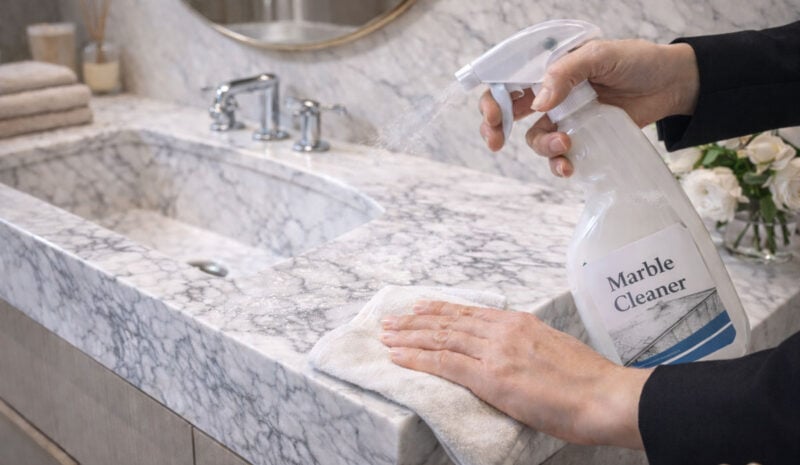
For daily cleaning, it is advisable to use pH-neutral cleaners specifically formulated for natural stone. These products effectively remove dirt and residues without attacking the calcium-based surface of marble. Using a soft microfiber cloth helps prevent micro-scratches and maintains a uniform finish, particularly on polished surfaces.
Warm water is often sufficient for routine cleaning, provided the surface is dried afterward. Drying is a frequently overlooked step but is essential to reducing water spots and mineral buildup. For light stains, specialized marble cleaners can be used to act gently without altering the stone’s structure.
Prompt cleaning of potentially staining substances such as perfumes or cosmetics is recommended. Even when sealed, prolonged exposure may increase absorption risk. Immediate care helps maintain the original finish and consistent appearance of the countertop.
Marble is particularly sensitive to acidic substances. Conventional limescale removers, vinegar-based cleaners, bleach, or ammonia can chemically react with calcium carbonate, causing dullness and surface etching. Repeated use of harsh detergents may create microscopic abrasions that compromise the finish over time.
Abrasive sponges or steel wool should never be used, as they can scratch the surface and damage the polished or honed finish. Once the surface layer is compromised, restoration typically requires professional refinishing, which involves additional cost and intervention.
Even generic multi-purpose cleaners should be used cautiously if they are not specifically designed for natural stone. Over time, unsuitable products may degrade the protective sealant applied to the countertop, reducing its resistance to moisture and staining.
Protective treatment is one of the most important elements in ensuring the durability of marble bathroom countertops. Marble is naturally porous and can absorb liquids if not properly sealed. The application of water-repellent and oil-repellent sealers reduces absorption capacity by creating an invisible protective barrier.
Sealing does not alter the aesthetic appearance of the marble but significantly enhances its resistance to stains. In residential settings, it is generally recommended to reapply sealant every one to two years, depending on usage intensity. A simple water drop test can help determine whether resealing is necessary: if water is quickly absorbed, the protective layer should be renewed.
A consistent maintenance schedule protects both the visual appeal and the long-term investment value of marble countertops, preventing the need for more invasive restoration work.
Marble bathroom countertops are extremely versatile from a design perspective. Their ability to complement materials such as wood, metal, glass, and ceramic makes them suitable for a wide range of interior styles. The choice of marble type and finish must align with the overall design language of the bathroom to create harmony among surfaces, colors, and volumes.
Marble can serve as the dominant focal point or function as a balanced design element within a more complex composition. Lighting, room dimensions, and color palette must all be considered carefully. Proper coordination enhances natural veining and elevates the perceived quality of the entire space.
In a modern minimalist bathroom, marble bathroom countertops are often selected with clean lines and straight edges. White or black varieties with subtle veining integrate seamlessly with floating vanities, smooth surfaces, and understated fixtures. The absence of decorative excess allows the material’s natural texture to stand out in a refined and controlled way.
Lighting plays a crucial role in this context. Recessed lighting or integrated LED strips placed beneath the vanity can emphasize the slab thickness and create a sense of visual lightness. The result is a contemporary environment where marble functions as an architectural element fully integrated into the overall design.
In a classic elegant bathroom, marble takes on a more decorative dimension. Edge detailing may include subtle profiling, and lighter marbles with pronounced veining help create a refined atmosphere. Pairing marble with solid wood cabinetry and fixtures in brushed gold or bronze enhances the overall visual impact.
In this setting, marble is not merely a functional surface but a material that references architectural tradition. The final effect is a harmonious space in which natural materials and carefully crafted details interact with balance and continuity.
In a spa-inspired luxury bathroom, marble is used to create a complete sensory experience. Warm-toned stones such as travertine or beige marbles promote a sense of relaxation and comfort. Honed or matte finishes diffuse light softly, avoiding excessive glare.
When combined with natural wood elements, soft lighting, and greenery, marble contributes to an environment dedicated to wellness and daily self-care. In this context, the countertop becomes part of a broader design strategy aimed at transforming the bathroom into a private retreat.
Choosing the right supplier is just as important as selecting the marble itself. Purchasing marble bathroom countertops requires attention to slab quality, fabrication expertise, and installation precision. The purchasing channel influences the level of customization, support, and warranty provided.
It is essential to evaluate not only price, but also the supplier’s experience and the opportunity to inspect the material before fabrication. An informed purchasing decision reduces the risk of defects, dimensional inaccuracies, or aesthetic outcomes that fail to meet expectations.
Specialized bathroom showrooms or stone suppliers typically offer a balance between customization and structured service. They provide samples, technical consultation, and often collaborate with qualified fabricators for custom work.
This purchasing route allows comparison among different marble varieties and access to professional guidance in selecting the most appropriate solution. It also offers greater transparency regarding delivery timelines and installation procedures.
Working directly with a stone fabricator allows for a higher level of personalization. Slab selection can take place at the fabrication facility, enabling direct evaluation of veining orientation and material characteristics. The process is often more flexible and tailored than large-scale industrial distribution.
Handcrafted fabrication requires specialized skills and close attention to detail. The result is a truly unique marble countertop, precisely adapted to the available space and specific design requirements.
Purchasing marble bathroom countertops online offers the advantage of quick price comparison and access to a wide range of options. However, it also presents challenges related to verifying slab quality and finish accuracy in person.
Without professional measurement, the risk of dimensional errors increases. Additionally, transporting a heavy and fragile material such as marble requires careful logistics management. Online purchasing may be suitable for standard solutions, but for high-end custom installations, direct consultation with a supplier or fabricator is often preferable.








Luxurious furniture in lightweight marble
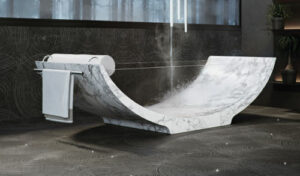
Dedalo is a company from Carrara that designs and produce monolithic luxurious furnishings in lightened marble, with a contemporary design. Our goal is to reaffirm the use of marble in everyday life without renouncing, for reasons of weight, to its three-dimensional vocation, proposing sculptural and extremely engaging shapes.