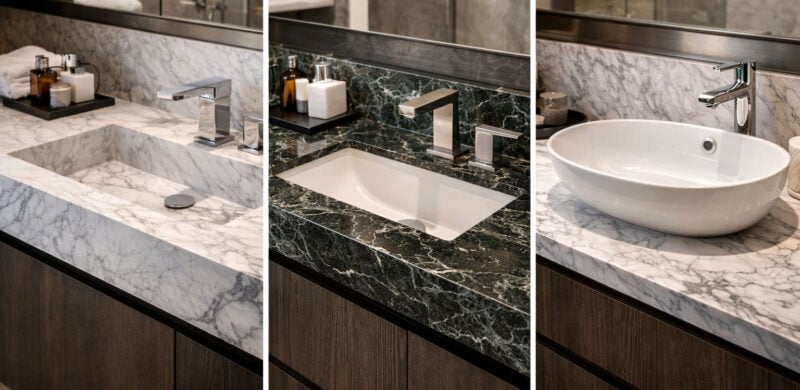
Contents
Bathroom countertops are one of the most decisive elements in contemporary bathroom design. They are not simply a surface to support the sink, but a structural and aesthetic component that directly affects the perceived quality of the entire space. A bathroom vanity countertop must withstand daily exposure to moisture, temperature changes, cleaning products, limescale, and mechanical stress, while maintaining stability and beauty over time.
In recent years the bathroom has become a more central space in residential design. It is no longer just a functional room, but a place dedicated to comfort and well-being. In this context, the countertop takes on an important architectural role. The choice of material, thickness, finish, and fabrication details determines the character of the entire project. A thin, industrial surface communicates technical minimalism, while a marble bathroom countertop with substantial thickness conveys solidity, prestige, and refinement.
Choosing correctly means evaluating not only aesthetics, but also durability, required maintenance, and long-term value. A quality countertop can stay with the space for decades without needing replacement, becoming a true structural investment.
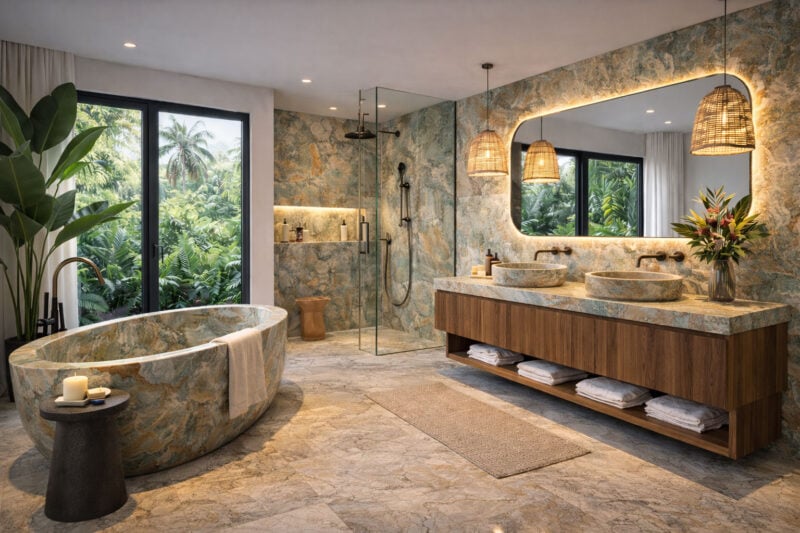
A bathroom countertop is the horizontal surface that holds the sink and can be installed over a vanity cabinet or mounted directly to the wall in a floating version. From a technical standpoint, its primary job is to support the sink’s weight and protect the structure underneath from water infiltration. However, reducing its role to a simple support would be limiting.
In the modern bathroom, the countertop is one of the most visible and character-defining elements. It sits at a central height, often at eye level, and immediately becomes the focal point of the space. A bathroom countertop sets the proportions of the vanity area, interacts with wall and floor finishes, and contributes to the perceived quality of the room.
When you choose a natural material like marble, the countertop is no longer just functional: it becomes a decorative element. Veining, color nuances, and material depth transform a technical surface into a high-end architectural feature. That’s why the countertop should be chosen with the same care you give to floors and wall finishes.
The term bathroom vanity countertop is often used generically to describe the surface that holds the sink. The concept of a vanity cabinet top refers to the countertop integrated into a storage structure, meaning it is part of a complete vanity system. The term bathroom countertops includes both solutions and refers to the slab or surface that performs the main structural function in the vanity area.
Understanding this distinction is essential when designing with substantial materials like natural marble. A natural marble countertop can have significant thickness and considerable weight. This requires careful evaluation of the cabinet’s load capacity or the strength of wall supports in the case of a floating installation. Proper, informed design prevents sagging, structural stress, or stability problems over time.
The difference is not only terminological but technical. Defining the solution correctly makes it possible to anticipate appropriate fabrication, suitable mounting systems, and results that match aesthetic and functional expectations.
From a technical point of view, the countertop must provide resistance to concentrated loads, humidity, and household chemical exposure. The surface must remain stable and not be prone to deformation. A low-cost material can deteriorate over time, swell, or lose flatness, compromising sink performance.
From an aesthetic point of view, the bathroom vanity countertop is one of the elements that most strongly defines the space. In a quality project, the surface becomes expressive. A marble bathroom countertop with a refined edge and substantial thickness creates a dramatic presence that immediately conveys prestige. Natural veining generates visual movement, making the bathroom a dynamic and sophisticated space.
The finish greatly influences the final perception. A polished surface amplifies light and highlights the veining, while a matte finish creates a more contemporary and refined, tactile effect. The choice between these options must be consistent with the architectural language of the overall space.
Bathroom countertop configurations vary depending on the sink type and the installation method. The choice must consider the size of the bathroom, the distribution of plumbing, and the desired aesthetic effect. Each solution has specific advantages and technical implications that should be evaluated carefully.
A countertop for a vessel sink is currently one of the most appreciated options for its strong visual impact. An undermount or drop-in configuration prioritizes continuity and practicality. An integrated sink countertop represents a refined, minimal solution. There are also floating countertops and countertops installed over a vanity, each with specific characteristics in terms of stability and visual result.
The final decision should not be driven only by personal taste, but by an overall analysis that includes functionality, maintenance, material weight, and design coherence.
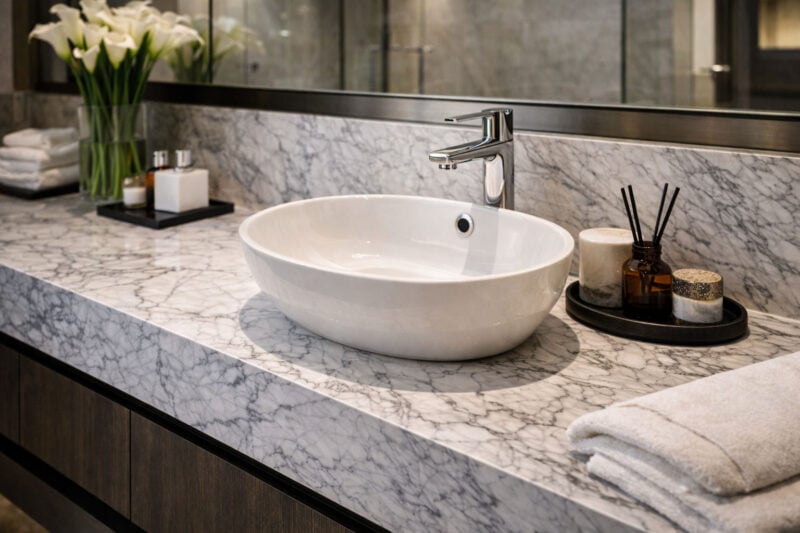
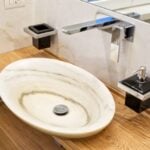
A countertop for a vessel sink means the sink is placed on top of the countertop surface, leaving the material fully visible. This configuration especially enhances premium materials like marble, because the entire surface remains the star of the space.
In a contemporary bathroom, combining a clean-lined vessel sink with a marble countertop creates an elegant contrast between geometry and natural materiality. The thickness of the slab becomes a distinctive element. Substantial thickness conveys solidity and increases the perception of quality. This solution is ideal for those who want a design bathroom with a strong visual identity.
From a technical standpoint, it is essential to plan precise holes for the drain and faucet. Marble fabrication in this case requires expert craftsmanship, because any mistakes can compromise the structural integrity of the slab.
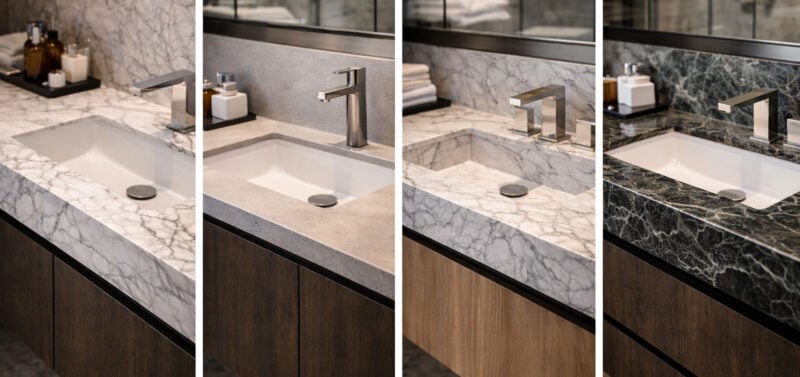
With a drop-in sink countertop, the sink is installed into the countertop surface. This solution provides greater visual continuity and makes daily cleaning easier, as it reduces the presence of exposed external edges.
When marble is chosen for a countertop with a cutout, fabrication must be performed with extreme precision. The opening must be perfectly calibrated to prevent structural tension or weak points. The final result is an elegant, functional countertop suitable for both modern and classic settings.
A drop-in configuration also helps make the best use of available space, maintaining order and linearity.
Material choice directly affects durability, maintenance, and the aesthetic result of bathroom countertops. There are industrial solutions such as laminate or composite materials, technical solutions such as porcelain (sintered/porcelain slab), and natural solutions such as marble.
Marble stands out for authenticity and value. Unlike artificial materials, every slab is unique. The veining cannot be reproduced identically, which gives the project exclusivity. From a technical standpoint, marble is a compact stone with good compressive strength and dimensional stability.
Its ability to be fabricated to custom specifications makes it possible to create personalized countertops, perfectly adapted to the project’s needs. In a high-end bathroom, a marble vanity countertop is not just a functional surface but a feature that communicates quality, attention to detail, and long-term solidity.
A marble bathroom countertop represents the premium choice par excellence. Structurally, it offers high resistance and stability. Its mass and compactness make it suitable for supporting loads without deformation. Aesthetically, it immediately conveys elegance and prestige.
Natural veining creates visual depth and movement. Each surface tells a unique geological story. This makes every countertop an unrepeatable piece. The possibility of choosing among different types of marble makes it easy to match any style, from contemporary minimalism to refined classic design.
When properly treated with water-repellent products, marble resists humidity and keeps its beauty for many years. Its longevity makes it not only an aesthetic choice but a long-term structural investment.
One of the aspects that most affects the visual impact of a marble bathroom countertop is thickness. Unlike industrial materials, marble allows substantial thickness options that immediately communicate solidity and prestige. A standard thickness can start around two centimeters, but in high-end projects, four- or six-centimeter solutions are often preferred to create a monolithic, highly architectural presence.
Edge treatment is another distinctive element. A straight edge communicates rigor and minimalism, while a slight chamfer visually lightens the slab. In classic or luxury contexts, profiled edges can be created with more articulated shapes that enhance the stone’s materiality. The surface finish also changes the final perception dramatically. A polished finish enhances the depth of the veining and amplifies brightness, while a honed matte finish creates a more contemporary, sophisticated look. Every choice should be consistent with the bathroom’s design identity.
When discussing a marble bathroom vanity countertop, it is essential to distinguish between natural marble and engineered marble. Natural marble is quarried in blocks and then cut into slabs. Each surface is unique, characterized by veining and tonal variations that cannot be replicated. This uniqueness is one of the main factors that determines its value.
Engineered marble, on the other hand, is made from stone fragments mixed with resins and pigments. It offers greater color uniformity and sometimes more consistent stain behavior, but it loses the authenticity and visual depth of natural stone. From an aesthetic perspective, natural marble has superior material complexity, capable of making a bathroom feel more elegant and distinctive. Those who want a truly exclusive environment tend to prefer natural stone, seeing it as a long-term investment and a premium feature that is difficult to replace.
Compared to other materials, marble bathroom countertops sit in the high-end tier for aesthetic value and prestige. Porcelain slabs are highly durable technical materials available in many finishes, including marble-look options. However, while practical and stable, they do not offer the same material depth and uniqueness as natural stone.
Quartz and engineered composites provide uniformity and good stain resistance, but they tend to look more homogeneous and less character-rich. Marble, by contrast, introduces a natural dimension that conveys solidity and authenticity. The best choice depends on the project’s goal. If you want a neutral, technical environment, porcelain or quartz can be valid solutions. If the aim is to create an upscale bathroom with strong identity and high perceived value, marble is the most coherent and distinctive option.
Longevity is one of the most important aspects when choosing bathroom countertops. Marble, when properly treated, delivers extremely long life compared to many industrial alternatives. Its compact structure makes it resistant in compression and stable over time. However, as a natural material, it requires some specific care.
Applying water-repellent sealers helps reduce liquid absorption and prevents staining. Daily cleaning should be done with neutral cleaners, avoiding acidic or aggressive products that can dull the surface. With regular maintenance, a marble bathroom vanity countertop can maintain shine and structural integrity for many years. A well-maintained marble countertop can easily exceed thirty years of use without losing aesthetic value, becoming an integral part of the home’s identity.
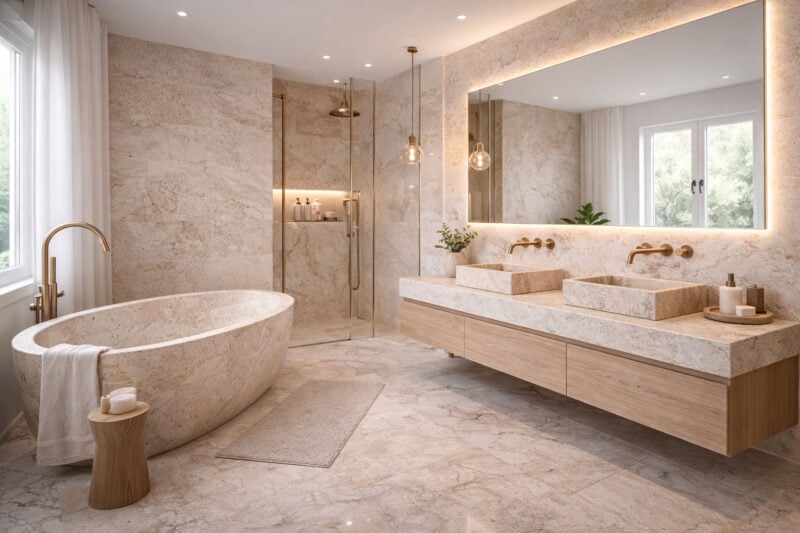
The price of bathroom countertops varies based on material, thickness, dimensions, and fabrication complexity. Budget solutions may appear convenient at first, but they often require replacement or major maintenance in the medium term. Marble involves a higher initial investment, driven by both raw material cost and the artisan fabrication required.
However, evaluating only the purchase price would be limiting. A marble bathroom countertop increases the perceived quality of the space and can positively affect the property’s value. In a mid-to-high-end renovation, the presence of premium natural materials is a distinguishing factor. Over the long term, marble’s durability and aesthetic performance more than compensate for the initial investment, making it a rational financial choice as well as an aesthetically superior one.
Choosing custom bathroom countertops means tailoring the vanity top to the actual needs of the space. Contemporary homes often have niches, out-of-square walls, or irregular areas that require personalized solutions. Marble, thanks to its workability, is perfectly suited to custom fabrication, allowing specific lengths, depths, and thicknesses.
Personalized design also makes it possible to maximize the natural veining by selecting the laying direction and the most harmonious portion of the slab. This level of control helps achieve a unique result that integrates perfectly with the architectural context. A custom countertop is not just a functional surface, but a design element that interacts with the entire space, improving proportions and visual balance.
Choosing a bathroom vanity countertop requires technical awareness. One of the most common mistakes is underestimating material weight, especially with marble, which requires proper supports and secure mounting. Another frequent error is choosing thickness that is too slim in contexts that call for stronger visual presence.
A lack of protective treatments can also compromise the countertop’s lifespan. With natural marble, it is essential to plan adequate sealing from the start, right at installation. Finally, failing to consider the coherence between countertop, wall finishes, and furnishings can lead to a disjointed result. Informed design choices and a quality-focused approach help avoid future issues and deliver a bathroom that is solid, elegant, and built to last.
What is the best countertop for a bathroom?
The best bathroom countertop depends on durability, moisture resistance, and maintenance needs. Quartz is often preferred because it is non-porous and highly resistant to stains and humidity. It offers long-term performance with minimal upkeep.
What is the least expensive bathroom countertop?
Laminate is typically the least expensive bathroom countertop option. It provides a wide range of colors and finishes at a budget-friendly price. This makes it ideal for cost-effective renovations or rental properties.
Can you replace just the bathroom countertop?
Yes, you can replace just the bathroom countertop without changing the entire vanity. The process involves removing the old surface and installing a new slab that fits the existing base. This approach reduces renovation time and overall costs.
How much is a bathroom countertop?
A bathroom countertop typically costs between $50 and $200 per square foot, depending on material and installation. Prices vary based on quartz, granite, laminate, or solid surface options. Labor, customization, and edge details also influence the final cost.








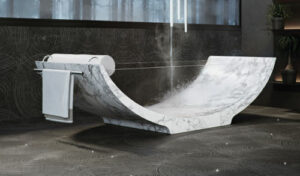
Luxurious furniture in lightweight marble
Dedalo is a company from Carrara that designs and produce monolithic luxurious furnishings in lightened marble, with a contemporary design. Our goal is to reaffirm the use of marble in everyday life without renouncing, for reasons of weight, to its three-dimensional vocation, proposing sculptural and extremely engaging shapes.